
Word chains are not just a fun activity but a powerful instructional tool deeply rooted in the science of reading. It is an essential component of your reading group. It is a great way for students to practice phonetic patterns, manipulate sounds in words, and read words. Chaining is also a quick and easy activity that students love!
WHAT IS CHAINING?
So, what exactly is chaining? It’s a sequence of words built by changing one sound at a time. It’s a fantastic way for students to practice phonetic patterns, manipulate sounds in words, and improve their reading skills. Imagine starting with a simple word like “at” and transforming it into a whole chain of words like cat > cot > hot > hat > pat > pan > an.
WHEN TO CHAIN
Now, let’s talk about when to use chaining. If you’re a classroom teacher, it can be a great warm-up or word work activity before diving into a decodable text. And if you’re a reading specialist or interventionist, you can incorporate chaining into specific interventions for your students. It’s versatile and adaptable to various teaching contexts.
CHAINING MATERIALS
The beauty of chaining lies in its simplicity and flexibility. You can use a variety of materials to facilitate this activity. Some options include whiteboards, magnetic letters, or cut-up letters. I’m a fan of the blue and red letters and foam magnetic letters available on Amazon.

HOW TO CHAIN
Step 1: Choose the skill: The chains you choose depend on your students and their needs. Ideally, the words in the chains will follow a specific pattern that students will find in the text they are reading (ex. short a, digraphs, silent e words). If you are using chaining as an intervention, the student’s skill gap should be the pattern. If you need a free Reading and Writing Assessment to find your starting point, grab one here.

Step 2: Gather your materials.
Step 3: Ask the student to make a word, for example, “cat” Have the student tap each letter and say the sound” c-a-t”. Then they can run their finger underneath and say the word “cat.”
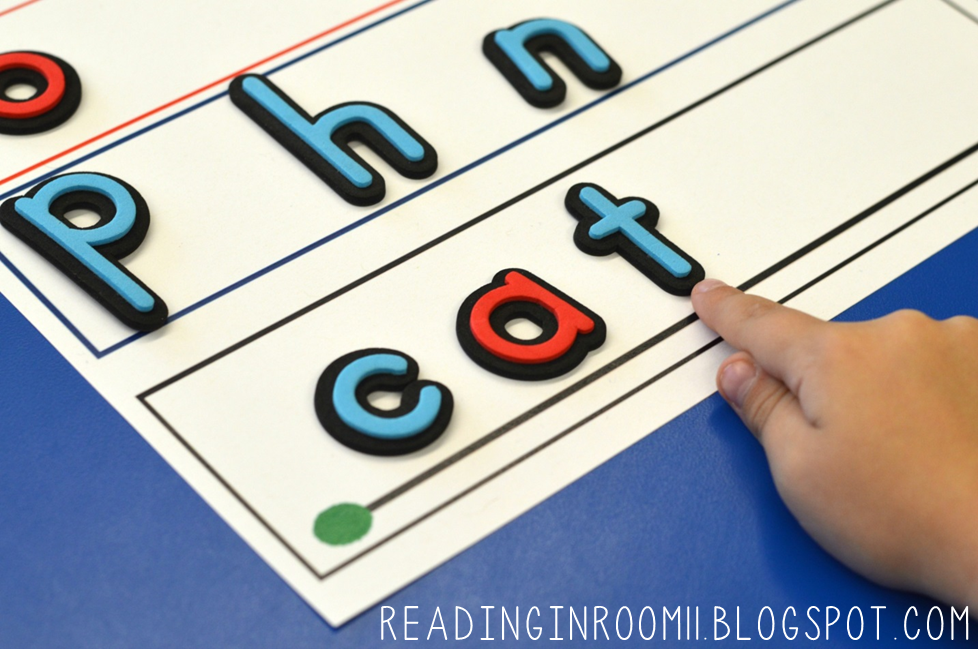
Step 4: Tell the student to change a sound so that “cat” says “cot” and repeat step 2. Repeat these steps until you have done 7-10 word chains.

Bonus Tips:
- When chaining, it is important to only change one sound/spelling at a time.
- Make sure you say that they are changing a sound not a letter.
- Do not tell the student what letter to change. You can prompt them to tap the words again to check their work if they make a mistake.
There are three ways to change the word.
- Change a sound: “Change a sound so that cot says hot”
- Adding a sound: “Add a sound so that at says cat”
- Deleting a sound: “Take a sound away so that pan says an”
Supporting Long Vowel Chaining with Silent “e”
If you are working on long vowels with a silent e, below is a picture of a trick we use at my school when having students chain. It is a great cue that the vowel will need to say its name and that the silent e does not make a sound.

HOW TO TEACH CHAINING
It is important to explicitly teach students how to chain. I made this presentation to use with students as a mini-lesson so I could model the steps of chaining before we did it together for the first time. It was extremely helpful! I have it for you (for FREE) in three different formats: PowerPoint, Google Slides and a Video. Click here to grab them all!
NOW IT IS YOUR TURN!
- I have a variety of resources to help you get started with word chains! These comprehensive interventions have a list of word chains integrated into each lesson. The pattern follows target skills and additional step build on students’ knowledge of the specific phonetic pattern.
- If you are unsure what skill your students need to focus on, check out these free reading and writing assessments.
- Loving the foam letters? Grab them from Amazon!
- Lastly, if you’re wondering how to incorporate chaining effectively into your reading group, check out “How to Plan the Perfect Reading Group.” It includes an overview of the essential components (including chaining) for a successful intervention plan.
FINAL THOUGHTS
Incorporating word chains into your lessons provides students with a hands-on and engaging experience that strengthens their phonological awareness, phonics knowledge, word recognition, vocabulary, fluency, and even their spelling and writing skills.
PIN FOR LATER

PS
This blog may contain some affiliate links, meaning I might earn a small commission if you decide to make a purchase through those links. It’s my way of keeping the blog up and running while providing you with valuable content. Your support is greatly appreciated!